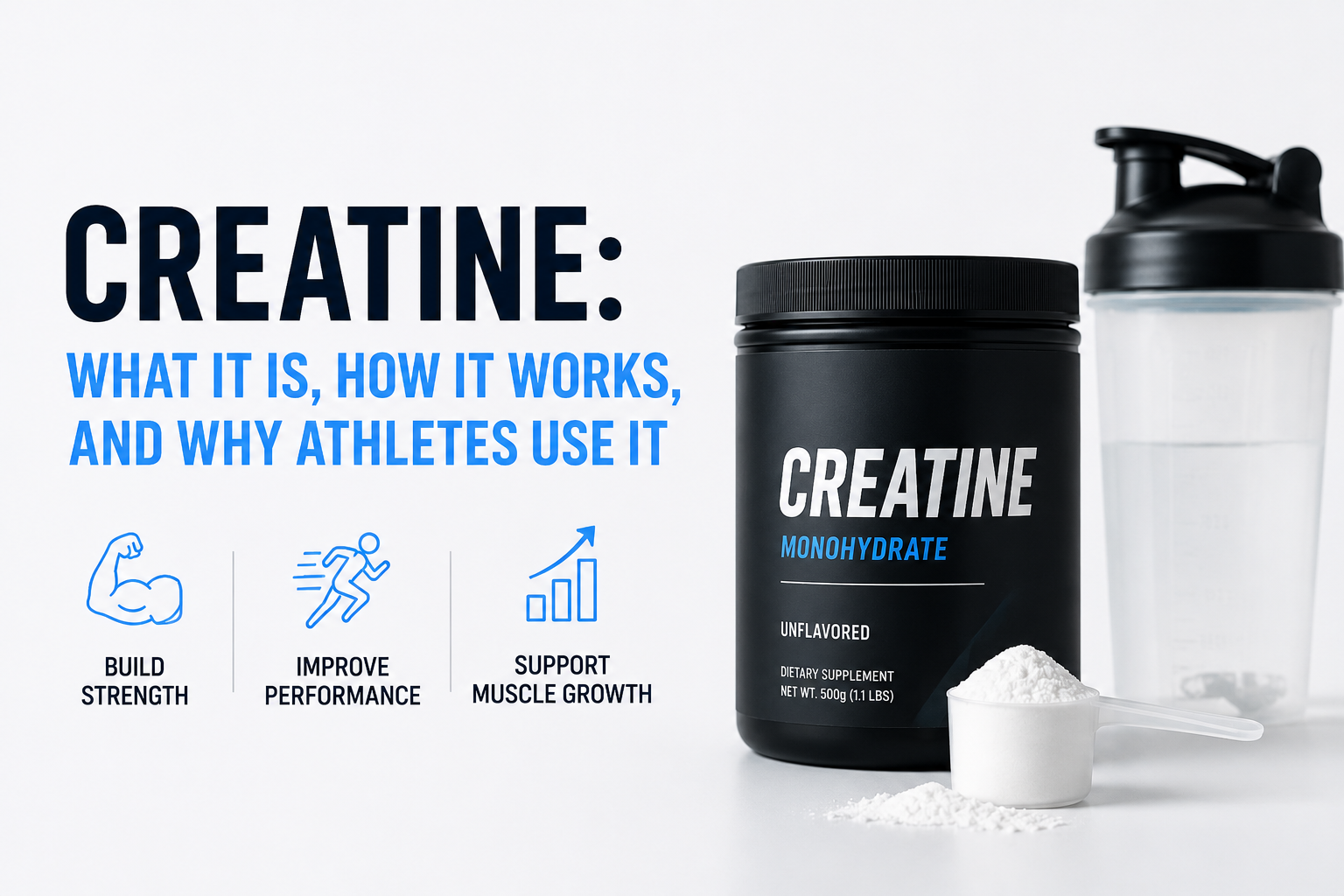
Creatine Guide 2026: What It Is, How It Works, and Why Athletes Use It
Creatine is one of the most researched supplements in sports nutrition and one of the few that consistently delivers results. Whether you want to build muscle, increase strength, or improve your performance in short, intense efforts, creatine is worth understanding. This guide covers everything you need to know.
What Is Creatine?
Creatine is a natural compound found mainly in muscle tissue. Your body produces it from amino acids (arginine, glycine, and methionine), and you also get small amounts from meat and fish. However, the amounts from food are far too low to maximize your muscle creatine stores that’s where supplementation comes in.
When you take creatine as a supplement, your muscles store it as phosphocreatine. This stored form is used to rapidly regenerate ATP the primary energy currency your body uses during explosive, high-intensity efforts like sprinting, lifting, or jumping.
How Does Creatine Work?
During intense exercise, your muscles use ATP at a faster rate than your body can produce it aerobically. Phosphocreatine acts as a fast backup: it donates a phosphate group to ADP, quickly regenerating ATP so your muscles can keep working at high intensity.
The practical effect: you can do more reps, lift heavier, sprint harder, and recover faster between sets. Over weeks and months, this translates into significantly greater muscle and strength gains.
What Does the Research Say?
Creatine monohydrate is one of the most studied supplements in existence. Here’s what the evidence consistently shows:
- Increases strength and power output in short, intense efforts
- Supports muscle hypertrophy (growth) when combined with resistance training
- Improves performance in repeated sprint activities
- May support cognitive function, particularly under sleep deprivation or mental fatigue
- Well-tolerated by healthy adults across a wide range of doses
A 2003 meta-analysis of over 22 studies found that creatine supplementation resulted in an 8% greater increase in strength and a 14% greater increase in weightlifting performance compared to placebo. These are meaningful numbers.
Types of Creatine: Which One Should You Use?
Creatine Monohydrate
The gold standard. Creatine monohydrate is the most studied, most affordable, and most effective form. Almost all research on creatine has been done using monohydrate. If you’re choosing a creatine supplement, start here.
Creatine HCl
Creatine hydrochloride is more water-soluble than monohydrate, meaning you need a smaller dose. Some people find it causes less stomach discomfort. It’s more expensive and less studied than monohydrate worth trying if monohydrate doesn’t agree with you.
Creatine Ethyl Ester, Buffered Creatine, and Others
Various other forms exist, often marketed as superior to monohydrate. The evidence doesn’t support these claims. Save your money and stick with monohydrate.
How to Take Creatine
Do You Need a Loading Phase?
A loading phase (20g per day for 5-7 days, split into 4 doses) will saturate your muscles faster you’ll feel effects within a week. However, it’s not required. Taking 3-5g per day consistently will achieve the same saturation after 3-4 weeks, with less risk of digestive discomfort.
Maintenance Dose
After loading (or from the start if you skip it): 3-5g per day is the standard maintenance dose. Timing doesn’t matter much take it whenever is most convenient for you. Post-workout may have a slight edge, but consistency matters far more than timing.
Cycling
You don’t need to cycle creatine. Long-term use (years) is safe according to current research. If you stop taking it, your muscle creatine levels gradually return to baseline over 4-6 weeks.
Is Creatine Safe?
Yes for healthy adults, creatine monohydrate is one of the safest supplements available. Decades of research have not found meaningful evidence of harm at recommended doses.
- Kidney damage: No evidence in healthy individuals. If you have pre-existing kidney disease, consult your doctor.
- Hair loss: A single small study suggested a link; this has not been replicated in subsequent research.
- Water retention: Creatine draws water into muscle cells, which may add 1-2kg of scale weight in the first week. This is not fat gain.
- Stomach issues: Usually caused by taking too large a dose at once. Split doses or switch to creatine HCl.
Who Benefits Most from Creatine?
Creatine works best for:
- Strength and power athletes (weightlifting, sprinting, combat sports)
- Team sport athletes who rely on repeated explosive efforts
- People doing high-intensity interval training (HIIT)
- Older adults looking to maintain muscle mass and strength
Note: roughly 25-30% of people see limited benefit from creatine supplementation, likely because their baseline muscle creatine is already high due to high meat consumption.
Creatine and Brain Health
Emerging research suggests creatine isn’t just for muscles. Your brain also uses phosphocreatine as an energy buffer particularly during cognitively demanding tasks or periods of sleep deprivation. Studies have found improvements in memory, reaction time, and mental fatigue with creatine supplementation, especially in vegetarians and vegans who get little creatine from diet.
While the evidence is still developing, the potential cognitive benefits are another reason creatine stands out among supplements it may support both physical and mental performance simultaneously.
Creatine for Vegetarians and Vegans
Vegetarians and vegans typically have significantly lower baseline muscle creatine levels than meat eaters, simply because they consume no dietary creatine. This makes them excellent candidates for supplementation and research confirms they tend to respond more strongly to creatine than omnivores.
Good news: creatine monohydrate is synthetically produced and contains no animal-derived ingredients, making it suitable for vegans. Always check the label to confirm no animal-derived excipients are used in the capsule or coating.
What Happens When You Stop Taking Creatine?
When you stop supplementing, your muscle creatine levels gradually return to baseline over 4-6 weeks. You may notice a slight reduction in the water weight you gained during loading, and over time your strength and performance may edge back slightly. You won’t lose the muscle you built creatine doesn’t cause muscle loss when you stop, it simply removes the performance advantage that helped you build it.
There’s no physiological reason to stop taking creatine, and no evidence that cycling provides any benefit.
What to Look for When Buying Creatine
- Form: Choose creatine monohydrate micronised for better mixability
- Purity: Look for Creapure® certified products (produced in Germany to pharmaceutical standards)
- No fillers: A good creatine product contains creatine monohydrate and nothing else
- Price per serving: Creatine is cheap if you’re paying a lot per serving, you’re overpaying
For a comprehensive overview of the research, see the creatine research database on Examine.com.
Want to compare creatine products on price per serving? Check our creatine comparison to find the best value option.
Frequently Asked Questions
Does creatine build muscle on its own?
No. Creatine improves your capacity to train harder, which leads to greater muscle gain over time. Without resistance training, creatine won’t build muscle.
Can women take creatine?
Absolutely. Women benefit from creatine in the same ways men do. Research specifically in women shows improvements in strength, muscle mass, and exercise performance.
Does creatine cause bloating?
Some people experience mild water retention in the first week. This is intracellular (inside the muscles) rather than subcutaneous (under the skin), so it won’t make you look puffy.
Can I take creatine with protein powder?
Yes. They work through completely different mechanisms and can be taken together without any issue.
Bottom Line
Creatine monohydrate is one of the most effective, safest, and most affordable supplements available. If you train hard and want to get more out of your sessions, it’s one of the few supplements that consistently earns its place.
Ready to buy? Compare the best creatine products on BestSupplements4U and find the best price per serving.
Your words feel like they’ve been chosen with the utmost care — each one placed to guide us towards greater understanding.